Dental Implant Surgery Planned Around the Final Result
Dental implant surgery replaces missing tooth roots with implants positioned to support the teeth that will ultimately restore your smile and function. For Dr. E. Richard Hughes, that final restoration is where the planning begins.
“What kind of prosthesis do I want for the patient? That's the first thing. Then I build the implants around it.”
— Dr. E. Richard Hughes
Using a detailed clinical examination and 3D imaging when appropriate, Dr. Hughes evaluates the available bone, anatomy, bite, and restorative needs before determining implant position. The goal is not simply to place an implant, but to plan the surgery and restoration as parts of the same treatment.
3D Planning Before Dental Implant Surgery
Implant surgery begins well before the day an implant is placed. Dr. Hughes evaluates the final restorative objective, available bone, surrounding anatomy, existing teeth, and bite before determining where and how an implant should be placed.
When appropriate, three-dimensional imaging provides information that cannot be obtained from a conventional two-dimensional dental image alone.
Seeing the Implant Site in Three Dimensions
Cone beam computed tomography, commonly called CBCT, allows Dr. Hughes to evaluate an implant site in three dimensions. The scan can help show available bone and important anatomical structures near the proposed implant site.
Dr. Hughes considers that information together with the clinical examination and restorative plan. Imaging is a planning tool—not a substitute for clinical judgment.

Technology Is Used When It Improves the Treatment Plan
Digital planning can also be used to create a surgical guide that helps transfer a planned implant position to the mouth. Dr. Hughes does not treat a surgical guide as an automatic requirement for every implant case.
The decision depends on the anatomy, restorative requirements, complexity of the case, and whether guided surgery provides a meaningful clinical advantage.
The technology supports the treatment plan. The treatment plan is not built around the technology.
Available Bone
Bone volume and anatomy influence where an implant can be placed and what implant dimensions may be appropriate.
Nearby Anatomy
The proposed implant's relationship to neighboring teeth and anatomical structures is evaluated before surgery.
Restorative Position
The implant needs to be positioned for the crown, bridge, denture, or full-arch restoration it will ultimately support.
The Bite
Implant position and restoration design are considered in the context of how the patient's teeth come together and function.
What Happens During Dental Implant Surgery?
Dental implant surgery creates a stable foundation in the jaw for the tooth or teeth planned during the restorative phase of treatment. The exact procedure varies with the implant site, available bone, number of implants, remaining teeth, and whether additional procedures are needed.
In a straightforward case, Dr. Hughes prepares the planned site in the jawbone and places the implant in the position established during treatment planning. The implant then enters a healing phase during which the surrounding bone can integrate with its surface.
More involved cases may combine implant placement with tooth extraction, bone grafting, or other procedures. The sequence is individualized rather than using the same surgical protocol for every patient.
The implant itself replaces the missing root. After the appropriate healing and restorative stages, it can support a crown, bridge, removable implant-supported denture, or fixed full-arch restoration.
Learn More About Dental Implant Treatment →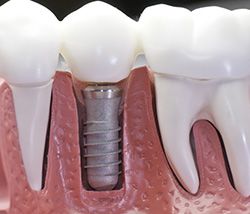
Plan
Determine where the finished restoration needs to be and plan the implant around that objective.
Prepare
Address the implant site and any extraction, grafting, or other preparation that is necessary.
Place
Position the implant according to the anatomy and restorative plan.
Heal & Restore
Allow appropriate healing before completing the planned implant restoration.
What If There Is Not Enough Bone for an Implant?
Bone loss can make implant treatment more complex, but it does not automatically mean that dental implants are not possible. Dr. Hughes evaluates how much bone is present, where it is located, and what the final restoration requires before deciding whether the site needs to be modified.
Bone Grafting
Bone graft material can be used when additional support is needed at an extraction socket or implant site. Whether grafting is necessary depends on the anatomy and treatment objective rather than being an automatic part of implant treatment.
Learn More About Bone Grafting →Ridge Expansion
In selected situations, a narrow area of jawbone may be able to be expanded to create sufficient width for implant placement. Whether this is appropriate depends on the individual anatomy and planned implant position.
Sinus Augmentation
In the back of the upper jaw, the available bone may be limited by the position of the sinus. In appropriate cases, augmentation of this area can create additional support for implant treatment.
Using Existing Bone Differently
Not every patient with bone loss needs the same grafting procedure. Implant dimensions, position, restorative design, and—for some full-arch cases—alternative implant configurations may provide another approach.
Use Healthy Existing Bone When It Can Be Used Effectively
Grafting is an important implant treatment tool, but the presence of bone loss does not mean every patient should automatically receive the same grafting procedure. Dr. Hughes evaluates the existing anatomy together with the final restorative goal before deciding how the implant site should be managed.
Patients who have previously been told they lack sufficient bone may still have treatment options after a complete implant evaluation.
Learn About Dental Implant Candidacy →Can a Tooth Be Removed and an Implant Placed at the Same Visit?
In appropriate cases, Dr. Hughes prefers to combine procedures when the clinical conditions allow it. A failing tooth may sometimes be removed, the site grafted if necessary, and the implant placed during the same surgical visit.
Combining treatment can reduce the number of separate surgical procedures, but Dr. Hughes does not force immediate placement when the site cannot provide the position or stability the implant needs.
When the Site Can Support the Planned Implant
After the tooth is removed, the remaining socket and surrounding bone must allow Dr. Hughes to stabilize the implant in the position required for the future restoration.
When those conditions are present, immediate placement may allow extraction, site management, and implant placement to become parts of one coordinated procedure.
Faster Is Not Automatically Better
If the remaining anatomy cannot provide appropriate implant stability or position, Dr. Hughes may recommend allowing the site to heal or rebuilding it before implant placement.
The objective is not simply to reduce the number of appointments. It is to create the right foundation for the restoration the implant will ultimately support.
Immediate Placement Does Not Mean Rushing Treatment
Combining extraction, grafting when needed, and implant placement can make treatment more efficient when the clinical conditions support it. When they do not, staging treatment can provide the better foundation.
Dr. Hughes chooses the sequence based on the anatomy, implant stability, and restorative objective rather than using the same protocol for every patient.
Explore Bone Grafting →How Does a Dental Implant Heal?
Implant placement is followed by a biological healing process in which the surrounding bone develops a stable connection with the implant surface. This process is known as osseointegration.
How treatment proceeds during this period depends on the implant site, initial stability, procedures performed, and the restoration being planned.
Bone Heals in Close Contact With the Implant
Initial mechanical stability is important when an implant is placed, but the longer-term foundation develops as living bone heals around the implant surface.
Protecting that process is one reason Dr. Hughes considers not only where an implant is placed, but also how it should function and be restored during the different stages of treatment.
There Is No Single Healing Timeline for Every Implant
An implant placed in an uncomplicated healed site may follow a different course than one placed at the time of extraction or in an area that also requires grafting or reconstruction.
Dr. Hughes evaluates the implant and surrounding tissues before determining when it is appropriate to proceed with the next restorative phase.
One-Stage vs. Two-Stage Implant Surgery
With a one-stage approach, a component extends through the gum tissue while the implant heals. With a two-stage approach, the implant is covered beneath the gum during the initial healing period and exposed during a later procedure.
Neither approach is automatically appropriate for every implant. The sequence depends on the implant site, stability, surrounding tissues, and restorative plan.
Can You Have a Tooth While the Implant Heals?
In selected cases, an implant may be able to support a temporary restoration during healing. Whether that is appropriate depends on implant stability, position, the restoration being supported, and the forces placed on it.
A temporary restoration does not mean that osseointegration is complete. When a provisional restoration is used, it must be designed and managed to protect the healing implant.
Full-arch approaches such as All-on-4® may also allow a temporary restoration to be attached during the surgical phase in appropriately selected cases.
What Is Recovery Like After Dental Implant Surgery?
Recovery depends on the extent of the procedure. Placement of one implant in a healed site can involve a different recovery experience from treatment that also includes an extraction, bone grafting, multiple implants, or other procedures.
Dr. Hughes and the Nova Implant Family Dentistry team provide postoperative instructions based on the treatment actually performed.
Recovery Varies With the Procedure
Tenderness and swelling can occur following oral surgery, but the amount and duration vary from patient to patient and with the extent of treatment.
Your individual postoperative instructions should take priority over general implant-recovery information because they are based on what was actually done during your procedure.
If you have questions about medications, eating, oral hygiene, temporary teeth, activity, or something you experience after surgery, contact the office for guidance specific to your case.
Feeling Better Is Not the Same as Being Fully Healed
Initial recovery from surgery and biological integration of the implant are different processes. The surgical area may begin to feel better while osseointegration is still taking place.
Decisions about chewing forces, temporary restorations, and moving forward with the final restoration are therefore based on Dr. Hughes' clinical evaluation rather than simply on how the area feels.
Have a Concern After Surgery?
If your recovery does not seem to be following the instructions you received, a temporary restoration or component feels loose or damaged, or you are concerned about something you are experiencing, contact Nova rather than waiting for your next scheduled visit.
Contact Nova Implant Family Dentistry →Why Implant Position and Your Bite Matter
Successful implant treatment is not simply about placing an implant into available bone. The implant has to support a restoration that fits the available space, looks appropriate, can be maintained, and functions within the patient's bite.
That is why Dr. Hughes plans implant surgery from a restorative perspective. Before determining where an implant should go, he considers what ultimately needs to be attached to it.
The Surgical Position Has to Work for the Tooth
An implant can be surrounded by bone and still be poorly positioned for the restoration it is expected to support. Its angle, depth, and relationship to neighboring teeth can affect the shape and position of the final crown or prosthesis.
Dr. Hughes considers those restorative requirements during surgical planning rather than treating implant placement and tooth replacement as separate problems.
“Fit tight, look right, and bite right.”
— Dr. E. Richard Hughes
An Implant Does Not Function by Itself
Dentists use the term occlusion to describe how the upper and lower teeth come together and function. Dr. Hughes considers not only the implant itself but also the forces created when the patient bites and chews.
He has evaluated and treated implant complications in which bite overload contributed to problems around an implant. That clinical experience is one reason occlusion is considered from the beginning rather than only after the final tooth has been made.
One Dentist Can Plan the Implant and Restore It
For patients who come directly to Nova for implant treatment, Dr. Hughes generally performs both the surgical placement and restorative phases of care. The dentist determining where the final tooth needs to be is therefore directly involved in deciding where the implant should be placed.
Meet Dr. E. Richard Hughes →Why Choose Dr. Hughes for Dental Implant Surgery?
Implant treatment combines diagnosis, surgery, restorative dentistry, and management of the patient's bite. Dr. E. Richard Hughes has more than 30 years of experience in implant dentistry and provides both surgical and restorative implant care at Nova Implant Family Dentistry.
Diplomate, American Board of Oral Implantology/Implant Dentistry
Dr. Hughes holds Diplomate status with the American Board of Oral Implantology/Implant Dentistry (ABOI/ID), an advanced board credential in implant dentistry.
He has also served as an ABOI/ID Oral Examiner, evaluating dentists pursuing board certification in implant dentistry.
His background spans both implant surgery and implant prosthodontics—the restorative side of treatment—allowing him to evaluate where an implant should be placed and how it should support the finished restoration.
30+ Years in Implant Dentistry
Dr. Hughes has practiced implant dentistry for more than three decades, including straightforward and complex implant treatment.
ABOI/ID Board Examiner
His professional roles have included examining dentists pursuing advanced board certification in implant dentistry.
Surgery + Restoration
Dr. Hughes' experience encompasses both implant placement and implant prosthodontics, allowing the two phases to be planned together.
Advanced Professional Involvement
His background includes implant education, lecturing, clinical investigation, surgical demonstration, and professional review.
Continuity Throughout Implant Treatment
Implant care can involve decisions about extraction, grafting, implant position, healing, temporary teeth, the final restoration, and the patient's bite.
For patients treated directly at Nova, Dr. Hughes can remain involved across those stages instead of separating the surgical objective from the restorative result.
Learn More About Dr. E. Richard Hughes →
Dental Implant Surgery FAQs
Implant treatment varies from patient to patient, but these answers address common questions about surgery, healing, and treatment at Nova Implant Family Dentistry.
How long does dental implant surgery take?
The length of the procedure depends on what is being performed. A single implant in a healed site is different from treatment involving extraction, grafting, multiple implants, or other procedures. Dr. Hughes can explain the anticipated procedure after your treatment plan has been established.
Are you awake during dental implant surgery?
Implant surgery is performed with appropriate anesthesia for the surgical area. Nova also offers sedation options for patients who are anxious about dental treatment or undergoing more extensive procedures. The appropriate approach depends on the patient's health, procedure, and individual needs.
Is dental implant surgery painful?
The surgical area is anesthetized for treatment. After surgery, tenderness and swelling can occur as the area begins to heal. Recovery varies with the procedure and individual patient. Dr. Hughes provides postoperative instructions specific to the treatment performed.
Can a tooth be extracted and an implant placed the same day?
Yes, in selected cases. Dr. Hughes may be able to remove the failing tooth, manage or graft the extraction site as necessary, and place the implant during the same procedure when the anatomy allows appropriate implant stability and position.
Do I need a bone graft before getting a dental implant?
Not necessarily. Dr. Hughes evaluates the existing bone and the restorative objective before deciding whether grafting is needed. Some patients have sufficient bone without grafting, while others may benefit from grafting or another site-development approach.
Learn more about bone grafting .
How long does a dental implant take to heal?
There is no single healing period that applies to every implant. The site, available bone, initial stability, grafting or extraction, and planned restoration can all affect the treatment sequence. Dr. Hughes evaluates healing before proceeding with later restorative stages.
Can I have a temporary tooth while my implant heals?
In selected cases, yes. Whether a temporary restoration can be supported during healing depends on implant stability, position, the type of restoration, and the forces placed on it.
What is the difference between one-stage and two-stage implant surgery?
With a one-stage approach, a component extends through the gum while the implant heals. With a two-stage approach, the implant is covered during initial healing and exposed during a later procedure. The appropriate approach depends on the clinical and restorative situation.
Who performs my implant surgery and makes the replacement tooth?
For patients who come directly to Nova for implant treatment, Dr. Hughes generally manages both implant placement and the restorative phase. This allows implant position and the final crown, bridge, denture, or full-arch restoration to be planned together.
How do I know if I am a candidate for dental implant surgery?
Dr. Hughes evaluates your oral health, available bone, anatomy, bite, restorative needs, medical history, and other factors that may affect treatment planning and healing.
Read our guide to dental implant candidacy .
Find Out What Your Implant Treatment Would Actually Require
Dental implant surgery is not the same procedure for every patient. The condition of the tooth being replaced, available bone, implant position, bite, health considerations, and final restoration all influence how treatment should be planned.
During your evaluation at Nova Implant Family Dentistry, Dr. E. Richard Hughes can assess your situation and explain whether treatment may involve straightforward implant placement, extraction, grafting, immediate placement, staged treatment, or another approach.
Implant Dentistry
Implant Dentistry
Experience
Restoration